


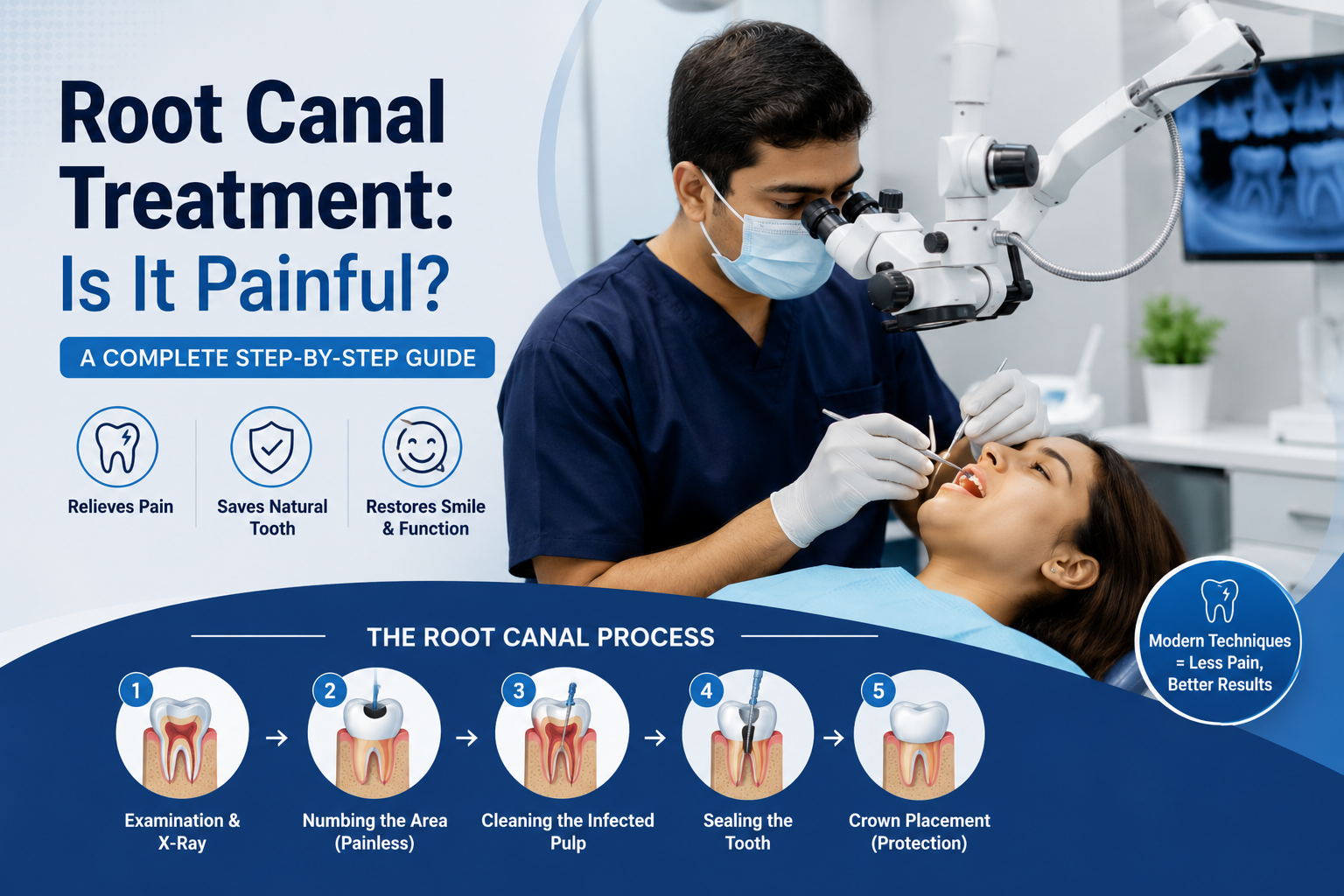
Root Canal Treatment: Is It Painful? A Complete Step-by-Step Guide
A root canal is a dental procedure that removes infected or inflamed pulp tissue from inside a tooth, disinfects the canal system, and seals it to prevent further infection.
Inside every tooth, beneath the enamel and dentin, sits a soft tissue called pulp — made up of nerves, blood vessels, and connective tissue. When bacteria reach this pulp, usually through deep decay, a crack, or trauma, it becomes infected and inflamed. Left untreated, this can lead to an abscess, bone loss around the root tip, and eventually loss of the tooth.
Root canal therapy (also called endodontic treatment) removes this damaged tissue while leaving the outer structure of the tooth intact, which is why it's considered a tooth-saving procedure rather than a destructive one.
Signs You Might Need a Root Canal
Common symptoms that bring patients in for evaluation include:
- Persistent or throbbing tooth pain, especially when chewing or applying pressure
- Prolonged sensitivity to hot or cold that lingers after the stimulus is removed
- Swelling or tenderness in the gums near a specific tooth
- A small bump (abscess) on the gum that may drain fluid
- Darkening or discoloration of a tooth
- A cracked or chipped tooth with visible or suspected pulp exposure
It's worth noting that some infected teeth show no symptoms at all and are only discovered during a routine check-up or X-ray, which is one reason regular dental visits matter even when nothing hurts.
What Causes the Need for a Root Canal?
- Deep tooth decay that has progressed past the enamel and dentin into the pulp
- Repeated dental procedures on the same tooth, which can irritate the pulp over time
- Cracks or fractures that allow bacteria to reach the inner tooth
- Trauma or injury, even without a visible crack, that damages the pulp's blood supply
- Untreated gum disease that spreads infection toward the root
Is Root Canal Treatment Painful?
Q: Does a root canal hurt? A: No — modern root canal treatment is performed under local anesthesia, so the tooth being treated is numb throughout the procedure. Most patients describe the experience as similar to getting a filling.
The pain that people associate with root canals almost always comes from the infection that made the treatment necessary in the first place, not the treatment itself. Once the infected pulp is removed and the pressure inside the tooth is relieved, most patients feel noticeably better within a day or two.
Some mild soreness in the days following treatment is common, especially around the injection site or if the tooth was significantly inflamed before treatment. This is typically managed with standard over-the-counter pain relief and settles on its own.
Root Canal Procedure: Step-by-Step
Q: What happens during a root canal, step by step? A: A root canal generally involves diagnosis and imaging, local anesthesia, isolating the tooth, accessing and cleaning the canals, disinfection, filling and sealing, and finally restoring the tooth with a filling or crown.
Step 1 — Examination and Digital X-ray The dentist examines the tooth and takes a digital X-ray (sometimes a CBCT scan for complex cases) to assess the extent of infection, the shape of the root canals, and whether the surrounding bone is affected.
Step 2 — Local Anesthesia The area around the tooth is numbed with a local anesthetic so you shouldn't feel pain during the procedure.
Step 3 — Isolating the Tooth A thin sheet called a rubber dam is placed around the tooth to keep it dry and free of saliva, and to protect the rest of the mouth during treatment.
Step 4 — Accessing the Pulp Chamber A small opening is made in the crown of the tooth to reach the pulp chamber and root canals.
Step 5 — Removing Infected Pulp Specialized fine instruments are used to remove the infected or dead pulp tissue from inside the canals.
Step 6 — Cleaning and Shaping the Canals The canals are cleaned, shaped, and disinfected, often using an antimicrobial irrigation solution to eliminate bacteria that hand instruments can't reach.
Step 7 — Filling the Canals Once clean and dry, the canals are filled with a biocompatible material (commonly gutta-percha) to seal the space and prevent reinfection.
Step 8 — Temporary or Permanent Restoration The access opening is sealed with a temporary or permanent filling. In many cases, the tooth will also need a crown afterward, since a root canal-treated tooth can become more brittle over time.
How Long Does It Take?
Most root canals are completed in one to two appointments of roughly 60–90 minutes each, depending on:
- The tooth involved (front teeth typically have one canal; molars can have three or four)
- The severity and complexity of the infection
- Whether a crown is needed as a follow-up visit
Front teeth are often treated in a single sitting, while molars with multiple curved canals may need two visits, particularly if there's significant infection that needs time to settle before final sealing.
Recovery and Aftercare
Q: What should I expect after a root canal? A: Mild soreness or tenderness for two to three days is normal. Most people return to regular activities the same day or the next.
Typical aftercare guidance includes:
- Avoid chewing on the treated side until the permanent restoration (filling or crown) is placed
- Stick to soft foods for the first day or two
- Take pain relief as recommended if there's discomfort
- Maintain regular brushing and flossing, being gentle around the treated tooth
- Attend the follow-up visit for a crown or permanent filling — skipping this step increases the risk of the tooth cracking later
Contact your dentist if you experience severe pain, swelling, or a fever after the procedure, as these are not typical and should be evaluated.
Root Canal vs. Tooth Extraction
| Factor | Root Canal Treatment | Tooth Extraction |
|---|---|---|
| Natural tooth | Preserved | Removed |
| Chewing function | Maintained | Requires replacement (implant/bridge) to restore |
| Bone preservation | Jawbone structure maintained | Bone can resorb over time without replacement |
| Adjacent teeth | Not affected | May shift into the gap over time |
| Follow-up treatment | Often needs a crown | May need implant, bridge, or denture |
| Long-term outcome | Generally favorable when followed by a crown | Effective, but replacement adds further treatment |
Dentists generally recommend saving a natural tooth through root canal treatment whenever it's feasible, since no artificial replacement fully matches the function of a natural tooth. Extraction is usually reserved for teeth that are too damaged, cracked below the gumline, or that have insufficient bone support.
Benefits of Saving Your Natural Tooth
- Preserves natural biting and chewing function
- Maintains the natural alignment of surrounding teeth
- Avoids the additional cost and time of implants or bridges
- Preserves a more natural appearance and jaw structure
- Prevents the bite from shifting, which can lead to jaw discomfort over time
Risks and Possible Complications
While root canal treatment has a strong long-term success rate, no procedure is entirely without risk. Possible complications include:
- Reinfection if the canal isn't fully sealed or a new cavity forms
- A cracked tooth if a crown isn't placed when recommended
- Rarely, an instrument fragment remaining in a canal during complex cases
- Persistent discomfort in a small number of cases, sometimes requiring retreatment or referral to a specialist
Choosing an experienced endodontist or dentist, and following aftercare instructions closely, reduces these risks significantly.
Who Is a Good Candidate?
You may be a good candidate for root canal treatment if:
- You have a tooth with infected or inflamed pulp but enough healthy structure remaining to restore it
- The surrounding bone and gum support are still adequate
- You'd prefer to keep your natural tooth rather than move to extraction and replacement
Who Should Avoid or Delay Treatment?
A root canal may not be recommended, or may need to be reconsidered in favor of extraction, if:
- The tooth is fractured below the gumline or has insufficient structure to restore
- There isn't enough bone support around the root
- The canal system is severely calcified or inaccessible
- The patient has certain underlying health conditions — your dentist will review your medical history before proceeding
Any decision here should be made after a clinical examination and X-ray, not from symptoms alone.
Technology Used in Modern Root Canals
Modern endodontic treatment relies on tools that make the process more precise and comfortable than older techniques:
- Digital X-rays for lower radiation exposure and instant imaging
- CBCT (Cone Beam CT) scans for a 3D view of complex root canal anatomy
- Rotary endodontic instruments for more efficient, consistent canal cleaning
- Apex locators to precisely measure canal length electronically
- Dental operating microscopes, used in more complex cases for better visibility
Cost Factors to Consider
Root canal costs vary depending on several factors rather than a fixed price:
- Which tooth is involved (molars with multiple canals typically cost more than front teeth)
- The complexity of the case and number of visits required
- Whether a CBCT scan is needed for diagnosis
- The material and type of crown placed afterward
- Whether treatment is done by a general dentist or a specialist (endodontist)
It's best to get a personalized cost estimate after an in-person examination and X-ray, since pricing depends on your specific tooth and condition.
Myths vs. Facts
| Myth | Fact |
|---|---|
| Root canals are extremely painful | Modern root canals under local anesthesia are generally comfortable; the infection causes the pain, not the treatment |
| Root canal treatment causes illness elsewhere in the body | This claim isn't supported by current dental or medical research |
| It's better to just pull the tooth | Saving the natural tooth is usually the preferred option when the tooth can be restored |
| One visit always fixes it permanently without a crown | Many root canal-treated teeth need a crown to prevent future cracking |
| Root canals aren't needed if the pain goes away | Pain subsiding can mean the nerve has died, not that the infection is gone — it still needs treatment |
Expert Tips for a Smoother Experience
- Don't wait for pain to become severe — early treatment is often simpler and more predictable
- Ask about sedation options if dental anxiety is a concern
- Follow up promptly for your permanent crown or filling
- Maintain good oral hygiene around the treated tooth to support long-term success
- Choose a clinic with an experienced endodontist for complex or multi-canal cases
At Dental Surgeons Planet, root canal cases are handled with the support of an in-house endodontist, Dr. Nishant Gandhi (MDS Endodontist), who focuses specifically on diagnosing and treating conditions of the tooth pulp and root canal system.
Prevention: Avoiding Future Root Canals
- Brush twice daily and floss to prevent decay from reaching the pulp
- Get cavities treated early, before they progress deep into the tooth
- Wear a mouthguard during sports to prevent trauma-related pulp damage
- Avoid chewing on hard objects like ice or pens, which can crack teeth
- Keep up with regular dental check-ups and X-rays to catch problems before they cause pain
Pre-Treatment and Aftercare Checklist
- Get a proper diagnosis with clinical exam and X-ray before assuming you need a root canal
- Ask your dentist about the number of visits expected for your specific tooth
- Eat a light meal before your appointment if a longer session is expected
- Avoid chewing on the treated tooth until the final restoration is placed
- Take pain relief as advised if there's mild soreness afterward
- Schedule your crown or permanent filling appointment promptly
- Maintain regular oral hygiene and follow-up visits
Frequently Asked Questions
1. Does a root canal hurt more than a filling? No, with local anesthesia, most patients find a root canal comparable to getting a deep filling.
2. How many sittings does a root canal take? Typically one to two visits, depending on the tooth and infection severity.
3. Can I drive myself home after a root canal? Yes, in most cases, since only local anesthesia is used and it wears off within a few hours.
4. Will I need a crown after a root canal? Often yes, especially for back teeth, since a crown protects the tooth from cracking after treatment.
5. Is root canal treatment permanent? It's a long-term solution for most patients when followed by a proper restoration, though like any dental treatment its success depends on ongoing oral care.
6. What if I ignore the pain instead of getting treatment? Untreated infection can spread, leading to abscess formation, bone loss, and eventually loss of the tooth.
7. Can a root canal be done in one visit? Yes, for many single-canal teeth, though multi-canal or heavily infected teeth may need two visits.
8. Is root canal treatment safe? Yes, it's a well-established procedure performed routinely in general and specialist dental practice.
9. How soon can I eat after a root canal? You can eat once the numbness wears off, but it's best to avoid chewing on the treated side until the permanent restoration is placed.
10. Why does the tooth still feel sensitive after treatment? Mild sensitivity for a few days is normal as the surrounding tissue heals; persistent or worsening pain should be checked by your dentist.
11. Can a tooth that already has a root canal need retreatment? In some cases, yes — if reinfection occurs or the seal is compromised, retreatment or specialist referral may be needed.
12. Is a root canal better than an implant? They serve different purposes — a root canal saves your natural tooth, while an implant replaces a tooth that can't be saved. Saving the natural tooth is generally preferred when possible.
13. Does insurance typically cover root canal treatment? Coverage varies by provider and plan, so it's best to check directly with your insurer.
14. Can children need root canal treatment? Yes, children can need a similar procedure (pulp therapy) if decay or trauma reaches the pulp of a baby or permanent tooth.
15. What's the success rate of root canal treatment? Root canal treatment has a favorable long-term success rate, particularly when followed by a timely crown and good oral hygiene.
16. Will the tooth change color after a root canal? Some root canal-treated teeth can darken slightly over time; a crown or other cosmetic option can address this if it's a concern.
17. Can I get a root canal on a front tooth? Yes, front teeth can also develop pulp infection from decay or trauma and are treated with the same core process.
18. How do I know if it's an infection or just sensitivity? Lingering pain after hot/cold, pain when biting, or gum swelling point toward possible infection rather than simple sensitivity — an exam is the only way to confirm.
Summary
Root canal treatment removes infected pulp tissue from inside a tooth, relieves the pain caused by that infection, and preserves the natural tooth instead of requiring extraction. With modern local anesthesia, digital imaging, and rotary instruments, the procedure itself is generally no more uncomfortable than a routine filling — the discomfort patients fear usually comes from the untreated infection, not the treatment. Most people recover within a few days and go on to keep a fully functional tooth for years with proper aftercare and a follow-up crown where needed.
If you're experiencing persistent tooth pain, sensitivity, or swelling, an early evaluation can often mean simpler treatment and a better outcome. The team at Dental Surgeons Planet in Powai, Hiranandani Gardens, sees patients from across Powai, Chandivali, Saki Vihar, Vikhroli, Ghatkopar, Kanjurmarg, Bhandup, Andheri East, Marol, and the IIT Bombay area for root canal evaluation and treatment — book a consultation to get a clear diagnosis and treatment plan for your specific tooth.