


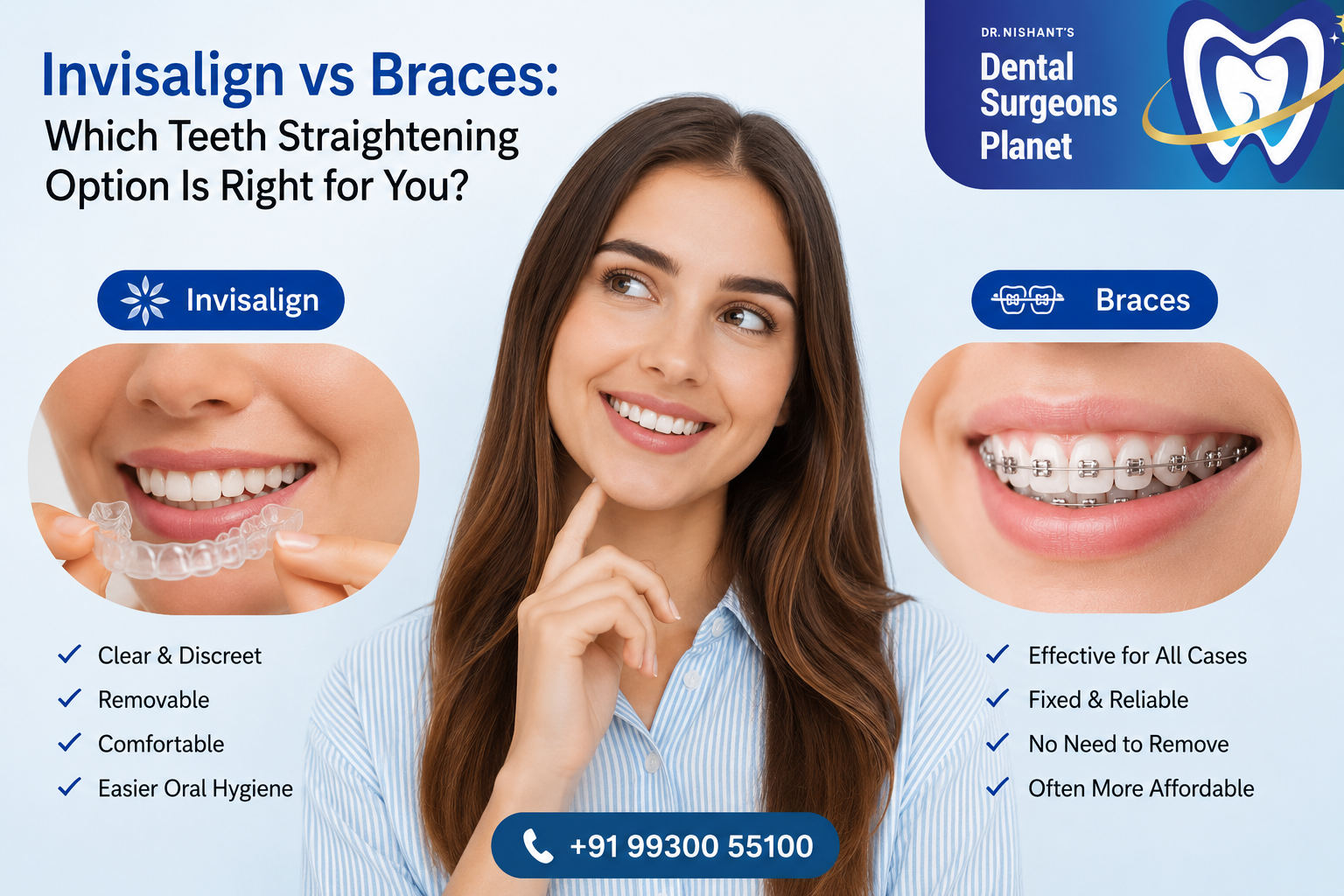
Invisalign vs Braces: Which Teeth Straightening Option Is Right for You?
What Is Invisalign?
Invisalign is a clear aligner system that uses a series of custom-made, removable plastic trays to gradually move teeth into their correct position. Each set of aligners is worn for about one to two weeks before being replaced with the next in the series, slowly shifting teeth without the need for metal wires or brackets.
Invisalign is designed using digital 3D scanning technology, allowing patients to see a projected outcome of their treatment before it even begins.
What Are Traditional Braces?
Traditional braces consist of metal or ceramic brackets bonded to each tooth, connected by an archwire that applies continuous, controlled pressure to move teeth over time. Periodic adjustments by the dentist tighten the wire, gradually guiding teeth into alignment.
Braces are fixed to the teeth for the entire treatment duration and cannot be removed by the patient, which ensures consistent, uninterrupted progress.
Common Signs You Need Teeth Straightening
You may benefit from Invisalign or braces if you experience:
Crowded or overlapping teeth
Noticeable gaps between teeth
An overbite, underbite, or crossbite
Difficulty biting or chewing properly
Jaw discomfort linked to misaligned teeth
Self-consciousness about your smile's appearance
Causes of Misaligned Teeth
Teeth misalignment can develop due to several factors, including:
Genetics and inherited jaw or tooth size
Childhood habits like thumb sucking or prolonged pacifier use
Early loss of baby teeth affecting permanent tooth positioning
Mouth breathing or tongue thrusting habits
Injury or trauma to the jaw or teeth
Invisalign vs Braces: Detailed Comparison
| Factor | Invisalign | Traditional Braces |
|---|---|---|
| Visibility | Nearly invisible, clear trays | Visible metal or ceramic brackets |
| Removability | Removable for eating and brushing | Fixed, cannot be removed |
| Comfort | Smooth plastic, minimal irritation | Wires and brackets may cause mouth irritation |
| Food restrictions | None, since aligners are removed to eat | Hard and sticky foods should be avoided |
| Oral hygiene | Easier, teeth brushed and flossed normally | Requires extra care around brackets and wires |
| Best suited for | Mild to moderate alignment issues | Mild to severe and complex bite issues |
| Treatment discipline | Requires wearing aligners 20-22 hours daily | No daily compliance needed, always active |
| Dental visits | Fewer in-person adjustments | Regular in-office adjustments needed |
Benefits of Invisalign
Nearly invisible, allowing confident smiling during treatment
Removable, making eating and cleaning teeth easier
Smooth plastic trays with less irritation to gums and cheeks
Custom digital treatment planning shows expected results in advance
Fewer dietary restrictions since aligners are taken out to eat
Benefits of Traditional Braces
Highly effective for complex and severe misalignment cases
No risk of losing or forgetting to wear a removable device
Continuous, round-the-clock treatment without patient compliance needed
Often more cost-effective for complicated orthodontic cases
Long-established treatment method with extensive clinical track record
Risks and Limitations of Both Options
Both treatments come with certain considerations:
Invisalign requires strict discipline - inconsistent wear can delay results
Invisalign may not fully correct severe bite or rotation issues
Braces can cause mouth sores or irritation from brackets and wires
Braces make cleaning teeth more challenging, raising the risk of plaque buildup
Both options carry a small risk of relapse if retainers aren't worn after treatment
Treatment Procedure: What to Expect
Invisalign Process
1. Initial consultation and digital 3D scan of your teeth
2. Custom treatment plan created showing projected tooth movement
3. Series of clear aligners manufactured based on the plan
4. Aligners worn 20-22 hours daily, changed every one to two weeks
5. Periodic dentist check-ins to monitor progress
6. Retainer provided after treatment to maintain results
Braces Process
1. Initial consultation, X-rays, and impressions taken
2. Brackets bonded to each tooth using dental adhesive
3. Archwire threaded through brackets and secured
4. Regular adjustment appointments every few weeks to tighten wires
5. Braces removed once desired alignment is achieved
6. Retainer provided to maintain new tooth position
Recovery and Adjustment Period
Both treatments involve a short adjustment period as your mouth adapts:
| Treatment | Initial Adjustment | Ongoing Sensation |
|---|---|---|
| Invisalign | Mild pressure for 1-3 days per new aligner set | Slight tightness when switching trays |
| Braces | Soreness for 3-5 days after placement or tightening | Temporary discomfort after each adjustment visit |
Neither treatment typically causes severe pain, and any discomfort is usually manageable and temporary.
Aftercare Tips for Both Options
For Invisalign:
Clean aligners daily with a soft brush and lukewarm water
Store aligners in their case when not in use to prevent loss or damage
Brush and floss teeth before reinserting aligners after meals
Wear aligners for the recommended 20-22 hours daily for effective results
For Braces:
Brush after every meal to prevent food from getting trapped in brackets
Use an orthodontic-friendly floss threader or water flosser
Avoid hard, sticky, or chewy foods that could damage brackets or wires
Attend all scheduled adjustment appointments
Cost Factors to Consider
Both Invisalign and braces vary in price depending on several factors:
Severity and complexity of the misalignment
Total treatment duration required
Material used, such as metal, ceramic, or clear aligners
Number of aligner sets needed for Invisalign
Additional diagnostic imaging or digital scanning required
Retainer costs after treatment completion
A clinical consultation is the most accurate way to understand cost specific to your case, as treatment plans are highly individualized.
Who Is a Good Candidate for Invisalign?
Invisalign may suit you if you:
Have mild to moderate crowding, gaps, or bite issues
Prefer a discreet, nearly invisible treatment option
Are disciplined enough to wear aligners consistently
Want the flexibility to remove trays for eating and special occasions
Have good oral hygiene habits
Who Is a Good Candidate for Braces?
Braces may be the better option if you:
Have severe crowding, rotation, or complex bite issues
Need a treatment that doesn't rely on daily patient compliance
Are a child or teen still undergoing jaw development
Have multiple orthodontic issues requiring precise, controlled movement
Prefer a fixed solution without the responsibility of removable trays
Technology Used in Modern Orthodontics
Modern orthodontic treatment relies on advanced tools for precision and predictability, including:
Digital intraoral scanners for accurate, comfortable impressions without traditional putty
3D treatment simulation software to visualize projected results
Digital X-rays for detailed diagnostic imaging with lower radiation
CAD-based aligner manufacturing for Invisalign's custom-fit trays
Self-ligating bracket systems for more efficient traditional treatment
Myths vs Facts
| Myth | Fact |
|---|---|
| Invisalign works faster than braces in every case | Treatment time depends on case complexity, not just the method used |
| Braces are only for children and teens | Adults make up a significant portion of orthodontic patients today |
| Invisalign can fix any dental issue | Invisalign is best suited for mild to moderate cases; severe cases may need braces |
| Braces are always painful | Discomfort is usually mild and temporary, similar to Invisalign adjustment periods |
| You can eat anything with Invisalign since it's removable | While there are fewer restrictions, aligners should still be removed before eating |
Expert Tips
Follow your dentist's recommended wear time for Invisalign strictly to avoid treatment delays
Keep a travel dental kit if you have braces to maintain hygiene on the go
Don't skip retainer use after either treatment, as teeth can shift back over time
Ask your dentist for a digital projection of results before starting Invisalign
Report any loose brackets or wires with braces promptly to avoid treatment setbacks
Prevention Tips for Healthy Teeth Alignment
Address childhood habits like thumb sucking early with professional guidance
Schedule early orthodontic evaluations for children around age seven
Maintain regular dental checkups to catch alignment issues early
Treat missing teeth promptly to prevent shifting of surrounding teeth
Wear retainers as prescribed after any orthodontic treatment
Checklist Before Choosing Your Treatment
Schedule a consultation with digital scanning or X-rays
Discuss the severity of your alignment or bite issue
Consider your lifestyle and ability to maintain aligner discipline
Ask about expected treatment duration for both options
Compare cost factors specific to your case
Clarify the aftercare and retainer plan for either treatment
Frequently Asked Questions
1. Is Invisalign as effective as braces?
For mild to moderate cases, Invisalign can be equally effective. For severe or complex misalignment, traditional braces are often more suitable.
2. How long does Invisalign treatment take compared to braces?
Both vary based on case complexity, but Invisalign often suits shorter treatment plans for milder cases, while braces may be needed for longer, more complex corrections.
3. Can I switch from braces to Invisalign or vice versa?
In some cases, a dentist may adjust the treatment plan, but this depends on your specific dental condition and progress.
4. Does Invisalign hurt more or less than braces?
Both involve mild, temporary discomfort during adjustment periods. Neither is typically described as significantly more painful than the other.
5. Can teenagers use Invisalign?
Yes, Invisalign is available for teens, though discipline in wearing aligners consistently is essential for it to work effectively.
6. How often do I need to visit the dentist with Invisalign?
Invisalign generally requires fewer in-person visits compared to braces, though periodic check-ins are still necessary to monitor progress.
7. Will I need a retainer after Invisalign or braces?
Yes, both treatments require a retainer afterward to maintain the corrected tooth position and prevent relapse.
8. Can Invisalign fix an overbite or underbite?
Invisalign can address mild to moderate bite issues, but severe cases may require traditional braces or additional orthodontic intervention.
9. Is Invisalign more expensive than braces?
Cost depends on case complexity and treatment duration for both options, rather than one being universally more expensive.
10. Can adults get braces instead of Invisalign?
Yes, adults commonly choose traditional braces, especially for more complex orthodontic corrections.
11. What happens if I don't wear my Invisalign aligners enough?
Inconsistent wear can delay treatment progress and may require additional aligner sets to achieve the planned results.
12. Are ceramic braces a good alternative to metal braces?
Ceramic braces offer a less visible alternative to metal braces while functioning similarly, though they may cost more.
13. Can I play sports with braces or Invisalign?
Both are generally safe for sports, though a mouthguard is recommended for contact sports to protect your teeth and appliance.
Summary
Both Invisalign and traditional braces are effective, well-established methods for correcting misaligned teeth, but they serve different needs. Invisalign offers a discreet, removable option best suited for mild to moderate cases and patients who can maintain consistent wear discipline. Traditional braces remain the more reliable choice for complex or severe orthodontic issues, offering continuous treatment without relying on patient compliance. The best way to determine which option suits you is through a detailed consultation and dental evaluation.
Ready to Straighten Your Smile?
Whether you're leaning toward Invisalign's discreet convenience or the proven reliability of traditional braces, the right choice starts with a professional evaluation. Our team at Dental Surgeons Planet, Powai, can assess your dental condition and guide you toward the treatment best suited to your needs. Patients from Powai, Hiranandani, Chandivali, Vikhroli, Ghatkopar, and nearby areas regularly visit for orthodontic consultations - book yours today