


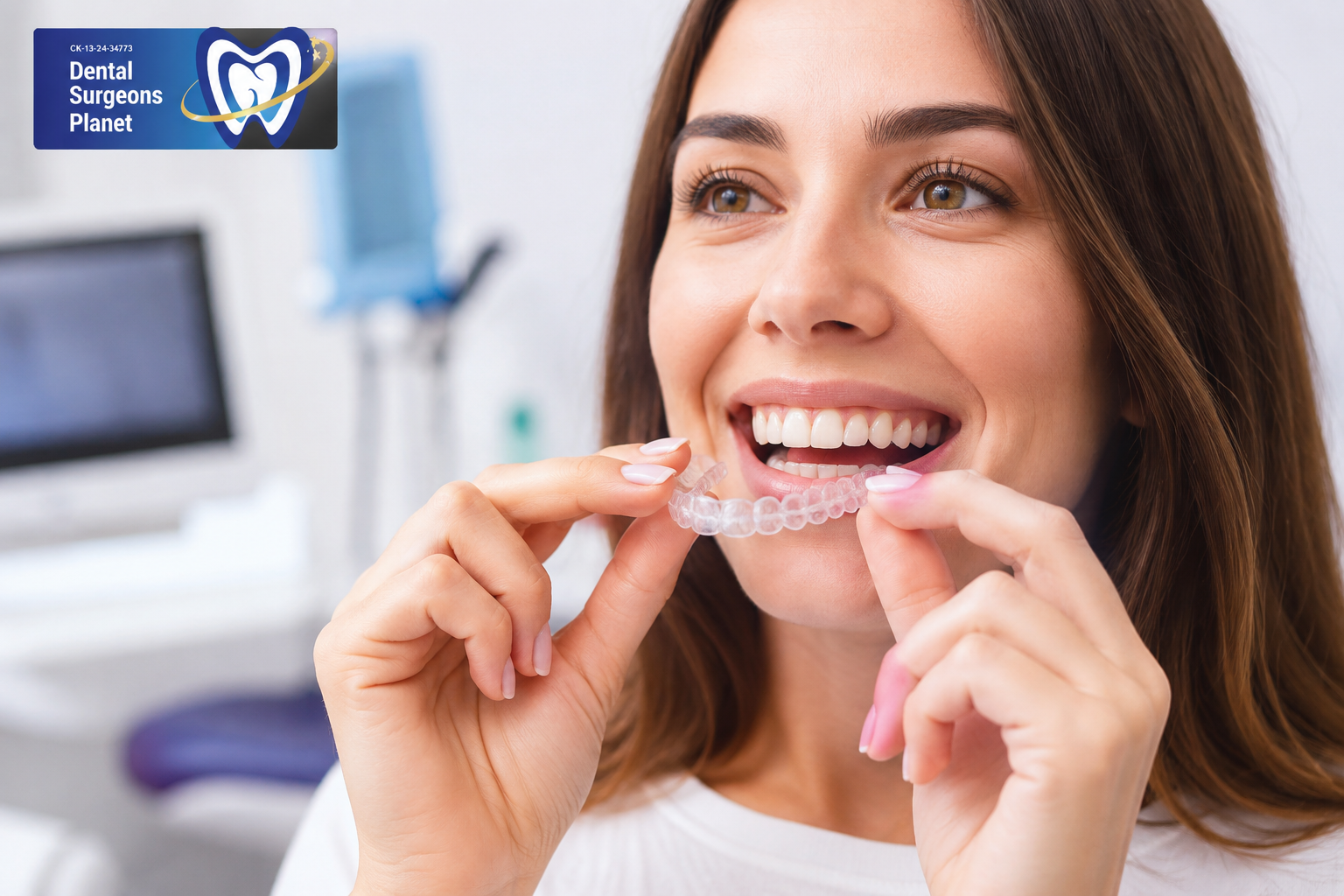
How Does Invisalign Work? Complete Treatment Process Explained
Invisalign has one of the most recognisable concepts in modern dentistry — clear, removable trays that straighten teeth without metal brackets or wires. Most people in Mumbai have heard of it, and a growing number are choosing it over traditional braces.
But understanding that Invisalign uses clear trays is very different from understanding how it actually works — how transparent plastic moves teeth through bone, what happens at each stage of the process, why some cases require small tooth-coloured attachments, how you know whether your teeth are tracking correctly, and what determines whether Invisalign can fully address your specific alignment concerns.
This guide answers all of those questions completely — from the biology of how aligners move teeth, through the step-by-step process from your first consultation to your final retainer, to the practical daily realities of living with Invisalign in Mumbai.
If you have been considering Invisalign treatment in Powai Mumbai and want to understand exactly what you are committing to before booking a consultation — this guide gives you that understanding.
The Biology — How Clear Aligners Actually Move Teeth
Before explaining the process, understanding the mechanism makes everything else clearer.
Teeth are not rigidly fixed in bone. They are held in the jawbone by a network of tiny elastic fibres called the periodontal ligament — a thin cushioning tissue that surrounds each root and connects it to the surrounding alveolar bone. This ligament exists because teeth need both stability and the capacity for movement — which is exactly what allows orthodontic treatment to work at any age.
When an aligner applies gentle, controlled pressure to a tooth in a specific direction, that pressure is transmitted through the periodontal ligament to the surrounding bone. On the side toward which the tooth is being pushed — the pressure side — bone resorption occurs. Specialised cells called osteoclasts break down bone in the direction of movement, creating a path for the root to follow. On the opposite side — the tension side — new bone is deposited by osteoblasts, filling in the space left behind as the root moves.
This process of bone resorption ahead of the root and bone deposition behind it is called remodelling, and it is the biological mechanism that makes all orthodontic treatment — braces and aligners alike — possible.
The critical insight about how Invisalign uses this mechanism is that each aligner is manufactured to be slightly different from the current position of your teeth — typically 0.25mm of movement per aligner. This small discrepancy means the aligner fits over your teeth with mild elastic tension. That tension generates the controlled pressure that initiates bone remodelling in the direction of the planned movement.
After approximately two weeks of wear, your teeth have moved to match the aligner shape. The aligner now fits passively — no more pressure. This is the signal to move to the next aligner in the series, which again has a small discrepancy from your current position, applying the next increment of planned movement.
This is why the two-week aligner change schedule exists — it matches the biological rate of bone remodelling rather than being an arbitrary interval.
Step 1 — Initial Consultation and Case Assessment
Everything begins with a consultation at an Invisalign-certified clinic in Powai Mumbai. This appointment determines whether Invisalign can achieve your treatment goals, what the realistic timeline looks like, and what the complete cost will be.
Your orthodontist assesses several things during this consultation:
Type and severity of misalignment
Invisalign handles crowding, spacing, mild to moderate overbite, crossbite, open bite, and cases where teeth have relapsed after previous orthodontic treatment very effectively. For severe skeletal discrepancies — where the issue is the jaw bone relationship rather than individual tooth positions — traditional braces or combined orthodontic-surgical treatment may be more appropriate. Your orthodontist will tell you honestly which category your case falls into.
Dental health status
Invisalign treatment cannot begin on unhealthy teeth. Active cavities, gum disease, significant tartar buildup, and untreated infections must be addressed first. A scaling and cleaning appointment before Invisalign begins is standard at Dental Surgeons Planet Powai. Attempting to move teeth through inflamed or infected supporting tissue both slows movement and risks accelerating bone loss.
X-ray review
A full-mouth or panoramic X-ray confirms root anatomy, bone levels, existing restorations, and any impacted teeth that might affect treatment planning.
Bite assessment
How your upper and lower teeth meet — your occlusion — determines which tooth movements are planned and what the final target bite relationship should be.
At the end of this consultation, you have a clear answer on Invisalign suitability, a realistic treatment duration estimate, and a cost breakdown for your specific case.
Step 2 — Digital Scanning and ClinCheck Treatment Planning
If you are a suitable candidate and decide to proceed, the next appointment involves digital scanning — the technological foundation of the entire Invisalign process.
The iTero scan
A handheld intraoral scanner is passed gently over the surfaces of your teeth, capturing a precise three-dimensional digital model of your complete dentition. The scan takes 5 to 10 minutes, requires no messy impression materials, and produces an immediately visible 3D model on screen that your orthodontist reviews with you in real time.
This digital model is uploaded to Invisalign's proprietary software — ClinCheck — where a complete three-dimensional treatment simulation is created showing the planned movement of every tooth at every stage from start to finish.
ClinCheck review
Your orthodontist reviews the ClinCheck simulation in detail — adjusting the planned movements, final tooth positions, and treatment staging to achieve the optimal result for your case. This is where clinical expertise matters considerably — the ClinCheck is a starting point that an experienced orthodontist refines based on clinical judgment, not an automatic output that is sent unchanged to the lab.
Patient simulation preview
Once your orthodontist is satisfied with the ClinCheck plan, you are shown the simulation — typically as a video of your teeth moving from their current positions to the planned final result. This is your digital preview of the expected outcome before any aligner is manufactured.
You can give feedback at this stage — concerns about specific tooth positions or aesthetic preferences are discussed and accommodated where clinically appropriate. Approval of the ClinCheck plan triggers manufacturing.
Aligner manufacturing
Invisalign manufactures all the aligners for your complete treatment simultaneously using precision CNC milling and thermoforming of medical-grade polyurethane resin sheets. Each aligner in the series is uniquely shaped for the tooth positions planned at that stage of treatment. Manufacturing typically takes 2 to 4 weeks after ClinCheck approval.
Step 3 — Attachments — What They Are and Why They Matter
When your aligners arrive, many patients encounter something they did not fully anticipate — attachments. Understanding what these are prevents confusion and manages expectations.
Attachments are small tooth-coloured composite resin bumps bonded to the surfaces of specific teeth before or during Invisalign treatment. They look like small raised dots or rectangular shapes on the tooth surface.
They exist because clear aligners work through surface contact between the plastic and the tooth. Smooth, round teeth — particularly canines and molars with bulbous surfaces — give the aligner limited ability to grip and apply force in precise directions. Attachments create geometric features on the tooth surface that give the aligner something to push against, enabling more complex and precise tooth movements.
Without attachments, Invisalign can straighten mildly misaligned anterior teeth relatively simply. With attachments, it can perform torque movements — rotating the root in a specific direction within the bone — and extrusion movements that bring teeth further out of the bone, which are significantly more complex biomechanical tasks.
Most comprehensive Invisalign cases require attachments on several teeth. Your orthodontist will explain which teeth need attachments and why during your treatment planning review.
Placing attachments
Attachment placement takes 20 to 30 minutes at a routine appointment before you receive your first aligners. The tooth surface is conditioned, composite resin is placed into a precisely shaped template, and the template is pressed against the tooth to form the attachment in the correct position and shape. No anaesthesia is required. The result is small tooth-coloured bumps that are visible on close inspection but significantly less noticeable than metal brackets.
Attachments are removed at the end of treatment by polishing — leaving the tooth surface clean and unmarked.
Step 4 — Receiving and Wearing Your First Aligners
The appointment where you receive your first set of aligners takes 30 to 45 minutes including attachment placement where required.
Your orthodontist shows you how to correctly insert and remove the aligners — using finger pressure at the back molars to seat them fully rather than biting them in, and removing them from the back on each side before the front. Proper insertion and removal technique protects both the aligners and the attachments from damage.
You leave with your first several sets of aligners, a carry case, and a cleaning kit.
Wearing schedule
Aligners must be worn 20 to 22 hours every day without exception. The only times they are removed are for eating any food or drinking anything other than plain water, brushing teeth before reinserting, and professional cleaning of the aligners themselves.
The 20 to 22 hour minimum is not a guideline — it is the threshold below which teeth do not move sufficiently between aligner changes to stay on schedule. Patients who wear aligners 16 to 18 hours daily move through treatment more slowly than planned and may require additional aligners at the end of treatment to complete movements that fell behind schedule.
The first few days
The first aligner creates noticeable pressure — the discrepancy between the aligner shape and your tooth positions is most noticeable with aligner one because your teeth have never been moved. This pressure — often described as tightness or pushing sensation — is the normal indication that the aligner is working. It typically reduces to background awareness within 48 to 72 hours as initial bone remodelling begins.
Speech is mildly affected for the first few days — a slight lisp when pronouncing s and sh sounds is common as your tongue adjusts to the presence of the aligner. This typically resolves within 3 to 5 days for most patients and is rarely noticeable to others beyond the initial adjustment period.
Step 5 — The Aligner Change Schedule and Monitoring Progress
Each aligner is worn for approximately two weeks before being replaced with the next in the series. Some orthodontists now use a 7 to 10 day change schedule for certain patients — particularly for cases with straightforward movements and excellent compliance — based on evidence that more frequent changes can be equally effective when teeth are tracking well.
Your specific change schedule is determined at the start of treatment based on your case complexity and compliance history.
Checking tracking
Tracking refers to how well your teeth match the intended positions at each stage of treatment — whether your teeth are moving as planned or falling behind the aligner's prescription.
The primary way to check tracking at home is to observe whether the aligner seats fully and evenly on all teeth when freshly inserted. A well-tracking aligner has no visible gaps between the aligner edge and the tooth surfaces near the gum margin. A poorly tracking aligner shows gaps — typically near specific teeth — indicating that those teeth have not fully moved to match the planned position for that stage.
Patients who notice consistent tracking gaps, particularly after aligner 5 or beyond, should bring this to their orthodontist's attention at the next check-in appointment. Persistent tracking failure is addressed by additional refinement aligners manufactured for those specific teeth.
Check-in appointments
Rather than the 4 to 6 weekly mandatory adjustment appointments required for braces, Invisalign patients typically attend check-in appointments every 8 to 12 weeks. These appointments allow your orthodontist to assess tracking, take photographs of progress compared to the planned ClinCheck stages, check attachment condition, assess the bite development, and address any concerns you have raised.
New batches of aligners are dispensed at these appointments when the previous batch has been completed.
Step 6 — Refinements — When and Why They Happen
Refinements are a normal and expected part of Invisalign treatment that many patients are not adequately prepared for before starting.
At some point during treatment — often after completing approximately 60 to 80 percent of the originally planned aligners — your orthodontist takes a new set of photographs and a new iTero scan to assess how closely the actual tooth positions match the ClinCheck-predicted positions at that stage.
For most cases, some discrepancy exists — certain teeth did not move exactly as planned, certain movements fell slightly behind schedule. Refinements are a new set of ClinCheck-planned aligners manufactured specifically to address these residual discrepancies and complete the treatment to the final target.
Refinements are included in most comprehensive Invisalign treatment fees — they are not an indication that treatment has failed or that your orthodontist made an error. They reflect the biological reality that tooth movement through living bone cannot be predicted with perfect precision across an 18-month treatment span. The ClinCheck is a plan, not a guarantee, and refinements are the mechanism for course-correcting the plan against the actual clinical progress.
Patients who are not told about refinements before starting treatment sometimes feel alarmed when their orthodontist recommends them. Being informed in advance that refinements are a routine part of comprehensive treatment removes this concern entirely.
Step 7 — Debonding and Retainers — The Final Step
When your orthodontist is satisfied that your teeth have reached the planned final positions — confirmed by clinical assessment and comparison with the ClinCheck target — treatment moves to completion.
Removing attachments
Attachments are polished off using a dental handpiece. The process takes 15 to 20 minutes and leaves tooth surfaces smooth and clean. No anaesthesia is required.
Final records
Photographs and a final iTero scan are taken to document your treatment result and to fabricate your retainers.
Retainer fabrication
Retainers are fabricated from the final scan — typically Vivera retainers, which are Invisalign's proprietary retention system, or clear retainers from your treating clinic. Fixed wire retainers bonded behind the front teeth are also commonly recommended in combination with removable retainers for comprehensive retention.
Why retention is permanent
The teeth moved during Invisalign treatment have new bone positions — but the periodontal ligament fibres that attach the tooth to the bone retain a memory of their original orientation for months to years after treatment. Without retainer wear, these fibres exert a slow, consistent pull toward the original tooth positions — causing relapse.
Retainers worn full time for the first 3 to 6 months, then nightly long-term, counteract this relapse tendency. Most orthodontists at Dental Surgeons Planet Powai recommend nightly retainer wear indefinitely — because the tendency for teeth to shift never fully disappears, and retainer wear is the only thing that reliably prevents it.
Patients who wore braces or Invisalign years ago and experienced relapse almost always stopped retainer wear before their teeth had fully stabilised in their new positions.
Invisalign for Different Case Types
Invisalign for crowding
Crowding — where teeth overlap due to insufficient arch space — is among Invisalign's most successfully treated case types. Mild to moderate crowding is addressed through a combination of arch expansion, interproximal reduction (removing tiny amounts of enamel between teeth to create space), and controlled tooth movement.
Invisalign for spacing
Gaps between teeth — particularly diastemas between the upper front teeth — respond very well to Invisalign. Closing spaces requires no enamel removal and is one of the faster movement types for clear aligners.
Invisalign for overbite
Moderate overbite — where the upper front teeth excessively cover the lower front teeth vertically — can be improved with Invisalign through posterior intrusion (moving back teeth slightly deeper into the bone to reduce their height) and controlled anterior tooth movement. Severe skeletal overbite may require combined orthodontic and surgical treatment.
Invisalign for crossbite
A crossbite — where one or more upper teeth sit inside the lower teeth when biting — can be corrected with Invisalign in most mild to moderate presentations. Severe skeletal crossbite affecting the entire bite relationship typically requires surgical correction.
Invisalign for relapse cases
Adults who had orthodontic treatment years ago and have experienced gradual relapse — teeth shifting back toward original positions after retainer wear was discontinued — are among the most straightforwardly treated Invisalign cases. The movements required are smaller than original treatment, compliance with wear is generally higher in adults than teenagers, and results are achieved relatively quickly.
Practical Daily Life With Invisalign in Mumbai
Eating and drinking
Remove aligners for all food and drink except plain water. This is the adjustment that most Mumbai patients find most significant — removing the aligners, eating, brushing, and reinserting. The discipline becomes routine within 2 to 3 weeks for most patients, but requires conscious attention initially, particularly in social settings like restaurants and at office meals.
Chai and coffee must be consumed without aligners. Both stain the clear plastic within days if worn during consumption. Hot drinks also warp the plastic slightly over repeated exposure. Most patients adapt to removing aligners before chai breaks — the key is ensuring total wear time reaches 22 hours despite the removals.
Cleaning aligners
Aligners are cleaned by gentle brushing with a soft toothbrush and cool water — not toothpaste, which is abrasive and scratches the plastic causing cloudiness. Specific Invisalign cleaning crystals or diluted retainer cleaning tablets are effective for deeper cleaning. Aligners should be rinsed every time they are removed and cleaned properly at least once daily.
Never use hot water to clean aligners — it warps the plastic.
Speaking
The lisp that many patients notice in the first few days typically resolves within a week for most patients. Reading aloud, having phone conversations, and general speaking practice accelerates adaptation. Very few patients — and very few people around them — notice any speech difference after the first week.
Sport and physical activity
Aligners can be worn during most physical activity. For contact sports where mouth impact is possible — cricket, football, martial arts — a sports mouthguard worn over the aligners is recommended, or the aligners can be removed and a sports mouthguard worn alone, with careful accounting for the time outside the aligners.
Invisalign Cost in Powai Mumbai — Complete Breakdown
| Treatment Type | Approximate Cost | Typical Duration |
|---|---|---|
| Invisalign Lite (minor cases) | ₹80,000 – ₹1,20,000 | 6 to 9 months |
| Invisalign Moderate | ₹1,20,000 – ₹1,80,000 | 9 to 15 months |
| Invisalign Comprehensive | ₹1,80,000 – ₹2,50,000 | 15 to 24 months |
| Invisalign Teen | ₹90,000 – ₹1,50,000 | 12 to 18 months |
| Vivera Retainers (post-treatment) | ₹8,000 – ₹15,000 | Ongoing |
| Refinements (if included) | Included in comprehensive | Varies |
Most clinics in Powai Mumbai offer EMI options through banks and financing partners, making the monthly cost of Invisalign treatment comparable to many other healthcare investments over the treatment period.
Invisalign vs Braces — The One-Paragraph Honest Summary
Invisalign and braces both move teeth through the same biological mechanism — controlled pressure causing bone remodelling. Invisalign does this with removable clear trays; braces do it with fixed brackets and wires. Invisalign offers superior aesthetics and hygiene flexibility. Braces offer more precise control for complex movements and eliminate the compliance variable. For mild to moderate cases in adults and compliant teenagers — Invisalign delivers comparable clinical outcomes with significantly better day-to-day experience. For severe complexity or patients who know their compliance will be inconsistent — braces deliver more reliable results. Your orthodontist's honest assessment of your specific case determines which is genuinely better for you.
FAQs
Q1. Does Invisalign hurt?
Each new aligner creates pressure and tightness for the first 2 to 3 days — this is the normal indication that planned movement is occurring. It is rarely described as pain and is consistently reported as significantly less uncomfortable than braces wire tightening. Over-the-counter ibuprofen for the first day or two of each new aligner manages any discomfort effectively.
Q2. Can Invisalign fix severe crowding?
Mild to moderate crowding — yes, very effectively. Severe crowding where significant arch expansion or extraction of teeth is required to create space may be better suited to traditional braces, which offer more precise control over complex extraction case mechanics. Your orthodontist will assess your specific crowding severity at consultation.
Q3. What happens if I lose an aligner?
Contact your Invisalign clinic in Powai Mumbai immediately. Your orthodontist will advise whether to wear the previous aligner to maintain tooth position while a replacement is ordered, or to move to the next aligner if sufficient movement has occurred. Replacement aligner manufacturing takes 1 to 2 weeks. Keep the previous aligner until you confirm the new one fits correctly.
Q4. Can I drink alcohol with Invisalign aligners in?
Alcohol should be consumed without aligners for two reasons — wine, beer, and spirits stain the plastic, and sugary mixers pooled against the teeth under the aligner create an ideal cavity-causing environment. Remove aligners for alcoholic drinks, rinse your mouth, and brush before reinserting.
Q5. Are the results of Invisalign permanent?
Invisalign results are as permanent as any orthodontic treatment — meaning they remain stable with consistent retainer wear and shift gradually without it. The teeth themselves have no preference for their new positions versus old ones in the early years of treatment completion. Retainer wear is what makes the result permanent.
Q6. How do I know if Invisalign is working — what should I look for?
The primary indicator is that each aligner fits fully and evenly without visible gaps near the gum margins when freshly inserted. Visible tooth movement comparing photographs taken at the start and at each check-in appointment is the most satisfying confirmation of progress. Your orthodontist reviews progress photographs at each check-in against the ClinCheck planned stages.
Conclusion
Invisalign works because of biology — the same bone remodelling process that makes all orthodontic treatment possible — delivered through a technology-driven system of precision-manufactured clear aligners that plan and execute tooth movement across dozens of stages from start to finish.
The process is more involved than the marketing summary of simply wearing clear trays. Digital scanning, clinical treatment planning, attachment placement, compliance with 22-hour daily wear, monitoring of tracking, refinements, and long-term retention are all components of a complete Invisalign experience that delivers consistently good results when each stage is properly managed.
Understanding the complete process before you start means no surprises during treatment — and patients who understand what they are committing to are the ones who comply most consistently and achieve the best outcomes.
Book your Invisalign consultation at Dental Surgeons Planet in Powai Mumbai today. A complete case assessment, digital scan, and ClinCheck preview of your expected result — all at your first appointment. See exactly what your new smile will look like before committing to a single aligner.
Clear teeth. Clear process. Clear results. Your Invisalign journey starts with one appointment.