


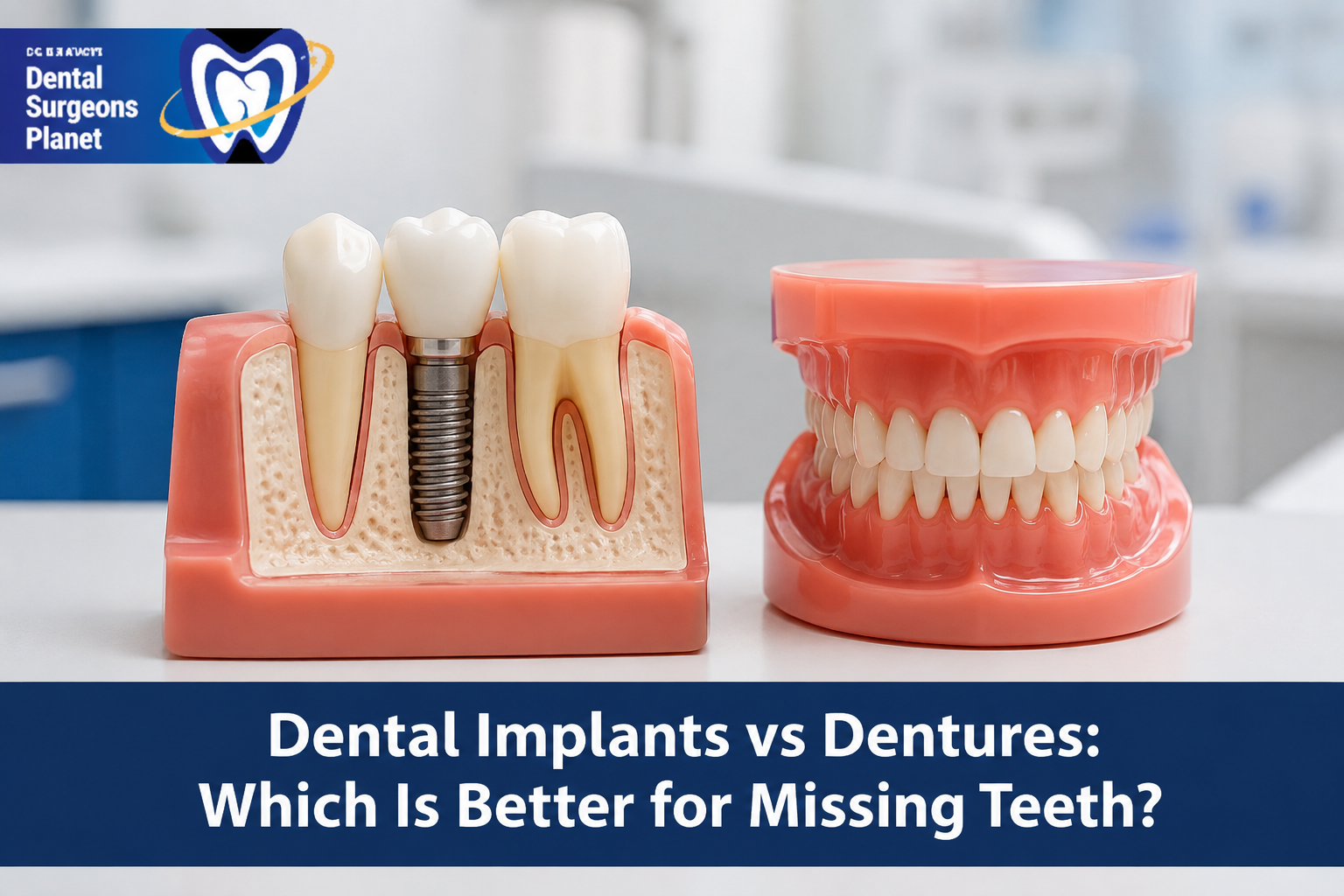
Dental Implants vs Dentures: Which Is Better for Missing Teeth
You are sitting across from your dentist and they have just told you that a tooth — or several teeth — need to come out. Or perhaps they are already gone, and you have been managing the gap for longer than you intended.
Now comes the decision that most patients are not fully prepared for — what to replace them with.
Two options come up in almost every consultation at dental clinics in Powai Mumbai. Dental implants and dentures. Both replace missing teeth. Both restore some degree of function and appearance. And both are available at a range of price points that vary significantly from each other.
But they are not equivalent solutions. They work differently, feel differently, last differently, and affect your jaw health in fundamentally different ways over the years following tooth loss.
This guide gives you the genuinely honest comparison that helps you make the right decision for your specific situation — not the one that benefits the clinic's revenue, but the one that benefits your long-term oral health, comfort, and quality of life.
Understanding the Core Difference
Before comparing specific factors, understanding what each option actually does at a biological level makes everything else clearer.
What a dental implant does
A titanium screw is placed surgically into the jawbone where the tooth root used to be. Over 2 to 3 months, the bone grows around and fuses with the titanium surface — a process called osseointegration — creating a bond that is as stable as a natural tooth root. A ceramic crown is then attached on top. The result is a fixed tooth that stimulates the jawbone during chewing exactly as a natural root did, preventing bone loss and functioning in every practical way like a natural tooth.
What dentures do
Dentures are prosthetic teeth set into an acrylic base that sits on top of the gum surface. They are held in place by suction, clasps on remaining teeth, or dental adhesive. They replace the visible tooth crowns — what you see when someone smiles — but provide no replacement for the tooth roots beneath the gum. The jawbone underneath receives no stimulation from biting and chewing forces, because nothing is anchored into it.
This fundamental difference — whether the jawbone receives stimulation or not — is what drives every other significant difference between the two options over time.
The Bone Loss Problem — Why It Changes Everything
This is the factor that most patients are not told clearly enough before choosing dentures, and it is the most important consideration in the entire comparison.
When a tooth is lost, the jawbone in that area begins to resorb — the body breaks down and reabsorbs bone that is no longer being stimulated by functional loading. This process begins within weeks of tooth loss and continues progressively over years.
What bone loss means practically for denture wearers
In the first year after tooth loss, measurable bone volume reduction occurs. Over 5 to 10 years of denture wear, the ridge of bone that the denture rests on has shrunk significantly. This is why dentures that fitted perfectly when first made become loose, uncomfortable, and poorly functional over time — the foundation they rest on has changed shape beneath them.
Loose dentures cause sore spots on the gum, difficulty eating foods that require biting force, the clicking sound that embarrasses patients in social situations, and the constant low-level anxiety of prosthetics that might dislodge unexpectedly during conversation or at a meal.
Dentures need relining — adding material to the fitting surface to accommodate the changed bone shape — and eventually complete replacement as bone loss progresses. This is not a one-time cost — it is an ongoing maintenance cost that continues for as long as dentures are worn.
What happens with dental implants
The titanium implant root transmits biting and chewing forces directly into the jawbone — exactly as a natural tooth root did. This stimulation signals the body to maintain bone density in that area. Bone loss is halted at the implant site. The jaw retains its shape. The implant remains stable. The crown on top does not shift or click.
This is the single most significant clinical advantage of dental implants over dentures — and the one that determines the largest difference in long-term quality of life.
Complete Comparison — Every Factor That Matters
Appearance
Both options can look natural immediately after fitting. Dentures made by a skilled dental technician with good-quality acrylic and teeth are cosmetically acceptable, particularly for full arch replacements.
Dental implant crowns, however, emerge from the gum at the same angle and with the same root structure simulation as natural teeth — because there is a root going into the bone. They reflect light the way natural teeth do. They do not have the slightly artificial, uniform appearance that full dentures can develop over time as the bone beneath changes shape.
For single or small numbers of missing teeth, the cosmetic difference between an implant crown and a partial denture is immediately apparent. The implant is indistinguishable from surrounding natural teeth. The partial denture's metal clasps are visible in most designs.
Comfort and function
Dental implants function identically to natural teeth. You eat what you want, bite with full normal force, and the prosthetic requires no conscious management during meals or conversation. Most implant patients report that within a few weeks of the crown being placed, they stop thinking about the implant entirely.
Dentures require adaptation. Most patients manage comfortably with well-fitted dentures for softer foods and moderate chewing. But biting into an apple, eating corn on the cob, or chewing particularly chewy foods remains challenging even with well-made, well-fitting dentures — and progressively more so as the dentures loosen over time with bone loss.
Stability
Implants do not move. They are anchored in bone. There is no risk of dislodgement during speaking, laughing, sneezing, or eating.
Conventional dentures rely on suction and adhesive for stability. Lower dentures — particularly full lower dentures — are notoriously difficult to stabilise because the lower jaw ridge offers less suction surface than the upper palate. The anxiety of prosthetics that might shift unexpectedly affects social confidence in ways that patients often do not anticipate before choosing dentures.
Oral hygiene
Implants are cleaned exactly like natural teeth — brushing and flossing normally. No special soaking solutions, no removal before sleeping, no adhesive residue to clean off the gums each morning.
Dentures are removed for cleaning and soaked overnight. The gum tissue beneath is brushed daily to remove bacteria that accumulate under the denture base. This routine is manageable but represents a daily maintenance difference from natural or implant-supported teeth.
Impact on adjacent teeth
Dental implants are entirely self-supporting. They require no modification of neighbouring teeth and do not place any functional load on them.
Partial dentures use clasps that hook onto adjacent natural teeth for stability. Over time, these clasps exert lateral forces on the clasped teeth that can loosen them and contribute to their eventual loss. Dental bridges — the fixed alternative to partial dentures — require grinding down the adjacent healthy teeth to create crowns that anchor the bridge, permanently altering perfectly healthy tooth structure.
Longevity
A well-placed dental implant at a qualified implant clinic in Powai Mumbai, maintained with good oral hygiene and regular professional checkups, has an expected functional lifespan of 20 to 25 years and frequently lasts a lifetime. The ceramic crown on top may need replacement after 10 to 15 years, but the implant itself continues functioning.
Conventional dentures need relining every 2 to 3 years as bone changes shape, and complete replacement every 5 to 8 years as the acrylic base wears and the fit becomes unacceptable. Over a 20-year period, the cumulative cost of denture maintenance often approaches or exceeds the original cost of dental implants.
Cost — initial and long-term
This is the factor that most influences the initial choice — and the one that looks most different over a 10 or 20-year perspective.
Single dental implant including crown: ₹25,000 to ₹60,000 — a one-time investment for that tooth position.
Partial or full denture: ₹8,000 to ₹30,000 initially — then relining costs every 2 to 3 years, replacement every 5 to 8 years, adhesive costs ongoing, and eventual additional implant costs if bone loss makes dentures unwearable.
Patients who choose dentures for financial reasons and then calculate the cumulative cost over 15 to 20 years consistently find the gap between implants and dentures is smaller than the upfront numbers suggest — and sometimes non-existent when long-term maintenance is included.
Implant-Supported Dentures — The Middle Option
For patients missing all or most of their teeth who want significantly better stability than conventional dentures without the cost of individual implants for every missing tooth, implant-supported dentures offer an important middle ground.
Two to four implants are placed in the jaw — fewer than the number of missing teeth — and the denture attaches to these implants using special connectors. The denture is still removable for cleaning but is held firmly in place during function by the implant attachments rather than relying on suction or adhesive.
The results are substantially better than conventional dentures — dramatically improved chewing force, no dislodgement during speaking or eating, significantly reduced bone loss compared to conventional dentures because the implants stimulate the bone at their sites, and much greater patient confidence in social situations.
Implant-supported dentures are available at Dental Surgeons Planet Powai and represent the most practical full-arch solution for patients who want the stability advantages of implants at a lower total cost than full individual implant replacement.
All-on-4 implants
All-on-4 is a specific implant-supported full arch solution where four strategically positioned implants support a complete fixed arch of teeth — no removable prosthetic, no nightly removal, no adhesive. The result is as close to natural teeth as any full-arch replacement option provides.
All-on-4 requires careful patient selection and thorough planning but delivers outcomes that completely transform quality of life for patients who have lost all their teeth and spent years managing conventional dentures.
When Dentures Are Still the Right Choice
After an honest comparison, there are genuine situations where dentures remain the most appropriate recommendation — and saying otherwise would not be serving patients honestly.
Patients with significant systemic health conditions — uncontrolled diabetes, active cancer treatment, severe osteoporosis on bisphosphonate medication, or conditions that compromise bone healing — may not be suitable for implant surgery until those conditions are better managed. In these cases, well-made dentures provide functional tooth replacement without surgical risk.
Patients with very limited bone volume who cannot undergo bone grafting due to health or personal preference may find dentures the most practical available option.
Patients for whom the upfront cost of implants represents a genuine financial hardship and who are committed to the maintenance requirements of dentures can be well-served by quality denture care — provided they understand what the long-term experience will involve.
Elderly patients in otherwise compromised health for whom the surgical and healing demands of implants present disproportionate risk relative to their remaining life expectancy and functional needs may be better served by high-quality dentures fitted by an experienced dental prosthetist.
The honest recommendation is always individual. What works for one patient is not the right answer for another — and a dental clinic in Powai Mumbai that recommends the same solution to every patient regardless of their specific situation is not providing genuinely patient-centred care.
The Decision Framework — Questions to Ask Yourself
Rather than a simple recommendation, these questions help you and your dentist reach the right decision for your specific situation:
How many teeth are missing and where are they located? Single or small numbers of missing teeth in visible areas represent the strongest case for implants over any alternative. Full arch replacement is where the comparison is most nuanced.
How is your general health? Medical conditions that affect bone healing, immune function, or surgical risk tolerance directly influence implant suitability.
What is your realistic budget — initial and over 10 years? Calculate both the upfront cost and the projected maintenance cost over a decade. The comparison often looks different when maintenance is included.
How important is stability and freedom from denture management to your daily quality of life? Patients who entertain frequently, speak publicly, or place high value on unself-conscious eating and social interaction consistently report higher satisfaction with implants than with dentures.
What is your bone volume? This requires a CBCT scan at an implant clinic in Powai Mumbai to assess. Insufficient bone may require grafting before implants — adding time and cost — or may make certain implant options impossible without grafting.
Dental Implants and Dentures — Cost Summary in Powai Mumbai
| Treatment | Approximate Cost | Expected Duration |
|---|---|---|
| Single dental implant with crown | ₹25,000 – ₹60,000 | 20 to 25 years or lifetime |
| Partial denture | ₹8,000 – ₹20,000 | 5 to 8 years before replacement |
| Full upper or lower denture | ₹15,000 – ₹30,000 | 5 to 8 years before replacement |
| Implant-supported denture (2 implants) | ₹60,000 – ₹1,20,000 | 10 to 15 years or longer |
| All-on-4 implants per arch | ₹1,50,000 – ₹3,50,000 | 15 to 25 years or longer |
| Bone grafting if required | ₹8,000 – ₹25,000 | One-time procedure |
| Denture reline | ₹2,000 – ₹5,000 | Every 2 to 3 years |
FAQs
Q1. Are dental implants painful to get in Powai Mumbai?
The procedure is performed under local anaesthesia and is not painful during surgery. Mild soreness for 2 to 3 days afterward is normal and managed with prescribed medication. Most patients report being surprised by how comfortable the experience was compared to their expectations.
Q2. How do I know if I have enough bone for a dental implant?
A CBCT scan — a three-dimensional X-ray of the jaw — at a qualified implant clinic in Powai Mumbai shows exactly how much bone volume is present. Patients with insufficient bone may require bone grafting before implant placement, which your dentist will discuss if relevant to your case.
Q3. Can implants fail? What is the success rate?
Dental implants placed by a qualified implant dentist in a suitable patient have a 95 to 98 percent success rate at 10 years. Risk factors that reduce success rates include smoking, uncontrolled diabetes, and poor oral hygiene. Your dentist will assess these factors before recommending implants.
Q4. Are dentures uncomfortable to wear every day?
Well-fitted new dentures are comfortable for most patients initially. Comfort decreases progressively as bone loss changes the shape of the ridge beneath the denture. Most denture wearers find comfort management becomes an increasing challenge after the first few years, particularly for lower dentures.
Q5. Can I switch from dentures to implants later?
Yes — but prolonged denture wear accelerates bone loss that may require bone grafting before implant placement. The earlier the switch, the more bone is available and the simpler the implant procedure. Waiting 10 years with dentures does not preclude implants but typically makes them more complex and costly.
Q6. How long does the full dental implant process take in Mumbai?
From implant placement to final crown fitting — typically 3 to 6 months, including the osseointegration healing period. Some cases qualify for immediate loading where a temporary crown is placed the same day as implant surgery, with the final crown fitted after healing.
Conclusion
The comparison between dental implants and dentures is not really about which option is better in the abstract. It is about which option is better for your specific clinical situation, lifestyle priorities, and long-term oral health goals.
With that said — for patients who are medically suitable and for whom the financial investment is manageable — dental implants are the superior long-term solution in almost every measurable dimension. They preserve bone, function like natural teeth, require no special maintenance, last decades, and eliminate the progressive comfort and stability problems that accompany denture wear as bone loss continues.
Dentures are a legitimate, valuable option for patients for whom implants are not suitable or not yet accessible. A well-made, properly maintained set of dentures provides meaningful functional restoration. But the limitations are real — and understanding them before choosing allows you to make a genuinely informed decision rather than discovering them years into the denture experience.
Visit Dental Surgeons Planet in Powai Mumbai for a comprehensive missing teeth consultation. A thorough clinical examination, CBCT imaging where appropriate, and an honest conversation about your specific situation will give you a clear, personalised recommendation — not a generic one based on what most patients choose.
Your missing teeth deserve a permanent solution. Book your consultation in Powai Mumbai today and find out which option is genuinely right for you.