


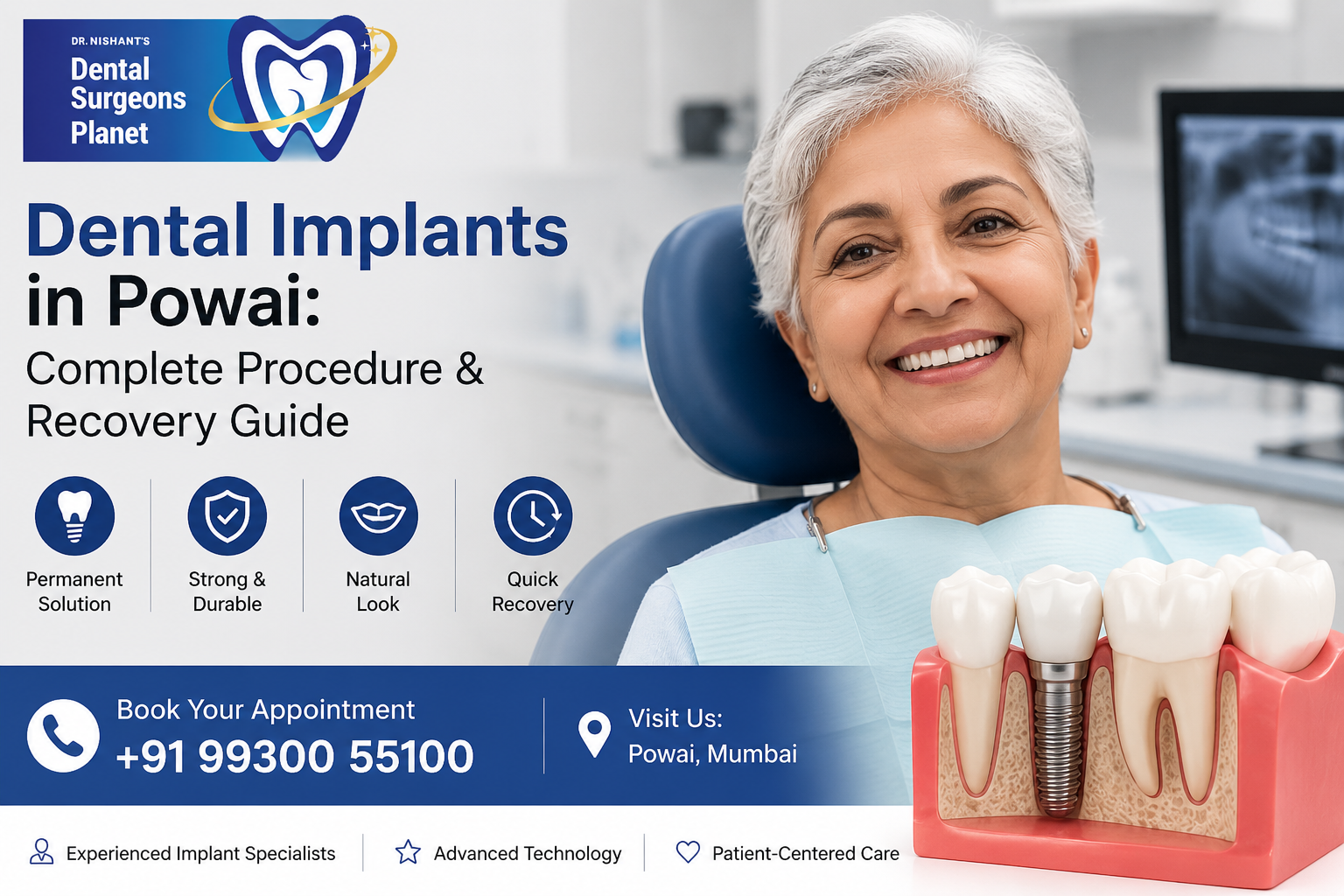
Dental Implants in Powai: Complete Procedure & Recovery Guide
What Are Dental Implants?
Dental implants are titanium or zirconia posts surgically inserted into the jawbone to act as an artificial tooth root, on top of which a crown, bridge, or denture is fixed. Unlike removable dentures, implants fuse with the jawbone through a biological process called osseointegration, giving them the stability and function of a natural tooth.
An implant has three main parts:
Implant post - the screw-like base placed inside the jawbone
Abutment - the connector piece that attaches the crown to the implant
Crown - the visible, tooth-shaped part custom-made to match your natural teeth
Because implants replace the root itself, they also help preserve jawbone density - something bridges and dentures cannot do.
Common Signs You May Need a Dental Implant
If you have one or more missing teeth, a loose or failing tooth, or an ill-fitting denture, a dental implant may be worth discussing with your dentist. Common situations include:
A single missing tooth from an accident or extraction
Multiple missing teeth affecting chewing or speech
A tooth that cannot be saved due to severe decay or infection
Denture wearers experiencing slipping, discomfort, or bone loss
Difficulty chewing certain foods due to gaps in the mouth
What Causes Tooth Loss?
Tooth loss in adults is commonly linked to:
Severe tooth decay that has destroyed the tooth structure
Advanced gum disease (periodontitis), which weakens the supporting bone
Trauma or injury to the face or mouth
Failed root canal treatment in some cases
Age-related wear combined with long-term neglect of oral hygiene
Understanding the underlying cause helps your dentist plan whether an implant can be placed immediately or if preparatory treatment is needed first.
Benefits of Dental Implants
Benefit | Why It Matters
Looks and feels natural | Custom-matched crowns blend with existing teeth
Preserves jawbone | Prevents the bone loss that occurs after tooth extraction
No impact on healthy teeth | Unlike bridges, adjacent teeth aren't filed down
Long-term durability | With proper care, implants can last for decades
Improved chewing and speech | Functions like a natural tooth root
Prevents teeth shifting | Fills the gap so neighboring teeth stay in position
Risks and Complications to Know
While dental implants have a strong success rate, no surgical procedure is risk-free. Possible complications include:
Infection at the implant site
Implant failure due to insufficient osseointegration
Nerve or sinus complications (rare, and minimized through proper imaging)
Gum recession around the implant
Prolonged healing in patients with certain health conditions
A thorough pre-treatment evaluation, including digital imaging, significantly reduces these risks.
Types of Dental Implants
The three main types of dental implants are endosteal, subperiosteal, and zygomatic implants, with endosteal being the most commonly used.
Endosteal implants - placed directly into the jawbone; the most widely used type for patients with adequate bone density
Subperiosteal implants - placed under the gum but on or above the jawbone, generally used when bone height is insufficient and grafting isn't preferred
Zygomatic implants - anchored in the cheekbone, reserved for cases with severe upper jawbone loss
Depending on how many teeth are missing, treatment may involve a single tooth implant, implant-supported bridge, or full mouth implants (All-on-4/All-on-6).
Dental Implant Procedure: Step-by-Step
The dental implant procedure typically involves an initial consultation, implant placement surgery, a healing period, and finally attachment of the permanent crown.
1. Consultation and Imaging - Digital X-rays or a CBCT scan assess bone density, nerve position, and sinus proximity to plan precise implant placement.
2. Treatment Planning - The dentist decides implant type, position, and whether bone grafting is needed.
3. Bone Grafting (if required) - For patients with insufficient bone, grafting material is added and allowed to heal for a few months before implant placement.
4. Implant Placement Surgery - Performed under local anesthesia; the implant post is surgically positioned into the jawbone.
5. Osseointegration - Over the following weeks to months, the jawbone naturally fuses around the implant, anchoring it securely.
6. Abutment Placement - Once integration is complete, a small connector piece is attached to the implant.
7. Crown Fitting - A custom-made crown, matched to your natural teeth in shape and shade, is fixed onto the abutment, completing the restoration.
Recovery Timeline After Dental Implant Surgery
Stage | Approximate Timeline | What to Expect
First 24-48 hours | Days 1-2 | Mild swelling, soreness, and slight bleeding
Initial soft tissue healing | Week 1-2 | Gums heal over the implant site; stitches may dissolve or be removed
Osseointegration | 2-6 months | Implant fuses with jawbone; no visible changes but critical healing phase
Abutment and crown placement | After full integration | Final restoration completed; normal chewing resumes
Recovery duration varies based on the number of implants, bone grafting needs, and individual healing capacity.
Aftercare Tips for Long-Lasting Implants
Good oral hygiene and regular dental checkups are essential to ensure an implant lasts for years. Recommended aftercare includes:
Brushing twice daily with a soft-bristled brush
Flossing daily, including around the implant crown
Avoiding hard or sticky foods immediately after surgery
Not smoking, as it significantly increases implant failure risk
Attending scheduled follow-up visits for professional monitoring
Using an antimicrobial mouth rinse if recommended by your dentist
Cost Factors for Dental Implants
Dental implant costs vary widely based on individual treatment needs. Rather than a fixed price, the following factors influence what you'll pay:
Number of implants required
Need for bone grafting or sinus lift procedures
Type of implant material (titanium vs zirconia)
Type of crown used (metal-ceramic, all-ceramic, zirconia)
Diagnostic imaging required, such as a CBCT scan
Complexity of the case, including existing gum or bone conditions
Single implant vs full mouth implant treatment
For an accurate estimate tailored to your specific case, a clinical consultation and imaging assessment is the best starting point.
Who Is a Good Candidate for Dental Implants?
You may be a suitable candidate if you:
Have one or more missing teeth
Have adequate jawbone density (or are open to bone grafting)
Have healthy gums with no active periodontal disease
Are in good general health with well-managed chronic conditions
Are committed to maintaining good oral hygiene post-surgery
Who Should Avoid Dental Implants?
Certain conditions may require additional evaluation or alternative treatments, including:
Uncontrolled diabetes or other unmanaged systemic conditions
Active gum disease that hasn't been treated
Insufficient jawbone density without willingness for grafting
Heavy smokers, due to significantly higher failure rates
Patients undergoing certain treatments like high-dose radiation therapy to the jaw
A dentist's evaluation is essential, as many of these factors can be managed or treated before implant placement.
Technology Used in Modern Implant Dentistry
Modern implant dentistry relies on advanced diagnostic and planning tools, including:
CBCT (Cone Beam CT) scans for 3D visualization of bone structure, nerves, and sinus position
Digital intraoral scanners for precise, comfortable impressions without traditional putty
Digital X-rays for detailed imaging with lower radiation exposure
Guided implant surgery software for accurate, minimally invasive placement
These technologies improve precision, reduce surgery time, and support better long-term outcomes.
Dental Implants vs Other Tooth Replacement Options
Factor | Dental Implant | Dental Bridge | Removable Denture
Preserves jawbone | Yes | No | No
Affects neighboring teeth | No | Yes (teeth are filed down) | No
Stability | Fixed and permanent | Fixed | Removable, can shift
Typical lifespan | Decades with proper care | 10-15 years | 5-10 years
Look and feel | Closest to natural teeth | Natural-looking | Less natural feel
Myths vs Facts
Myth | Fact
Dental implant surgery is extremely painful | Most patients report mild discomfort, managed with local anesthesia and standard pain relief
Implants require special daily maintenance | They only need normal brushing and flossing, like natural teeth
Implants are only for older adults | Implants are suitable for most adults with fully developed jawbones, regardless of age
Implants look artificial | Modern crowns are custom-shaded and shaped to match natural teeth closely
The procedure has a long, painful recovery | Initial recovery is usually just a few days; deeper healing happens without major discomfort
Expert Tips
Always get a CBCT scan before treatment planning for accurate bone assessment.
Avoid smoking for at least a few weeks before and after implant surgery to support healing.
Don't skip follow-up visits - early detection of issues prevents implant failure.
Ask your dentist about the specific implant brand and crown material being used.
Maintain routine dental cleanings even after full healing, as gum health directly affects implant longevity.
Prevention Tips for Long-Term Oral Health
Brush twice daily and floss consistently to prevent decay and gum disease
Visit your dentist for regular checkups and professional cleanings
Treat cavities and gum issues early, before they progress to tooth loss
Wear a mouthguard during contact sports to prevent dental trauma
Avoid excessive sugar and acidic foods that erode enamel over time
Checklist Before Getting a Dental Implant
Schedule a consultation with digital imaging (X-ray or CBCT)
Discuss your complete medical history, including chronic conditions
Ask about bone grafting needs, if any
Understand the full treatment timeline
Clarify aftercare and follow-up schedule
Discuss implant material and crown options
Ask about cost factors specific to your case
Frequently Asked Questions
1. How long do dental implants last?
With proper oral hygiene and regular dental visits, implants can last decades, and in many cases, a lifetime.
2. Is dental implant surgery painful?
The procedure is performed under local anesthesia, so patients typically feel pressure rather than pain. Mild soreness afterward is normal and manageable.
3. How long does the entire implant process take?
It generally takes 3 to 6 months from placement to final crown, depending on healing and whether bone grafting is needed.
4. Can I get a dental implant immediately after tooth extraction?
In some cases, immediate implant placement is possible, but this depends on bone condition and the reason for extraction. Your dentist will assess suitability.
5. Do dental implants require special care?
No special products are needed - regular brushing, flossing, and dental checkups are sufficient.
6. What happens if my jawbone isn't dense enough for an implant?
A bone grafting procedure can build up the required bone density before implant placement.
7. Are dental implants safe?
Dental implants are a well-established treatment with a strong long-term success rate when placed and maintained correctly.
8. Can smokers get dental implants?
Smoking increases the risk of implant failure, but many smokers still qualify after quitting or reducing use, based on dentist evaluation.
9. What's the difference between an implant and a bridge?
An implant replaces the tooth root and doesn't affect neighboring teeth, while a bridge relies on adjacent teeth for support.
10. Will people be able to tell I have a dental implant?
Modern implant crowns are custom-matched in shape and shade, making them very difficult to distinguish from natural teeth.
11. Can all missing teeth be replaced with implants?
Yes, options range from single tooth implants to full mouth implant solutions like All-on-4, depending on individual needs.
12. What is osseointegration?
It's the biological process where the jawbone fuses with the implant post, creating a stable, long-term foundation.
13. Is a CBCT scan necessary before implant surgery?
CBCT scans provide detailed 3D imaging of bone, nerves, and sinuses, allowing for safer and more precise implant planning.
14. Can diabetics get dental implants?
Patients with well-controlled diabetes can often get implants safely; uncontrolled diabetes may require management first.
15. How do I know if I need one implant or multiple?
This depends on how many teeth are missing and their location - your dentist will assess this during consultation.
16. What is the recovery time after implant surgery?
Initial soft tissue healing takes about 1-2 weeks, while complete bone integration takes a few months.
17. Do dental implants feel different from natural teeth?
Most patients report that implants feel and function very similarly to natural teeth once fully healed.
Summary
Dental implants remain one of the most effective, long-term solutions for missing teeth, offering benefits that removable dentures and bridges simply can't match - from jawbone preservation to a natural look and feel. The process involves careful planning, precise surgical placement, a healing period for osseointegration, and finally a custom-made crown. While recovery and cost vary by individual case, working with an experienced dental team and following proper aftercare significantly improves long-term outcomes.
Ready to Explore Dental Implants?
If you're dealing with a missing tooth or considering implants for the first time, a personalized consultation is the best next step. Our team at Dental Surgeons Planet, Powai, can assess your bone health, walk you through your options, and create a treatment plan suited to your needs. Patients from Powai, Hiranandani, Chandivali, Vikhroli, Ghatkopar, and nearby areas regularly visit for implant consultations - book yours today.